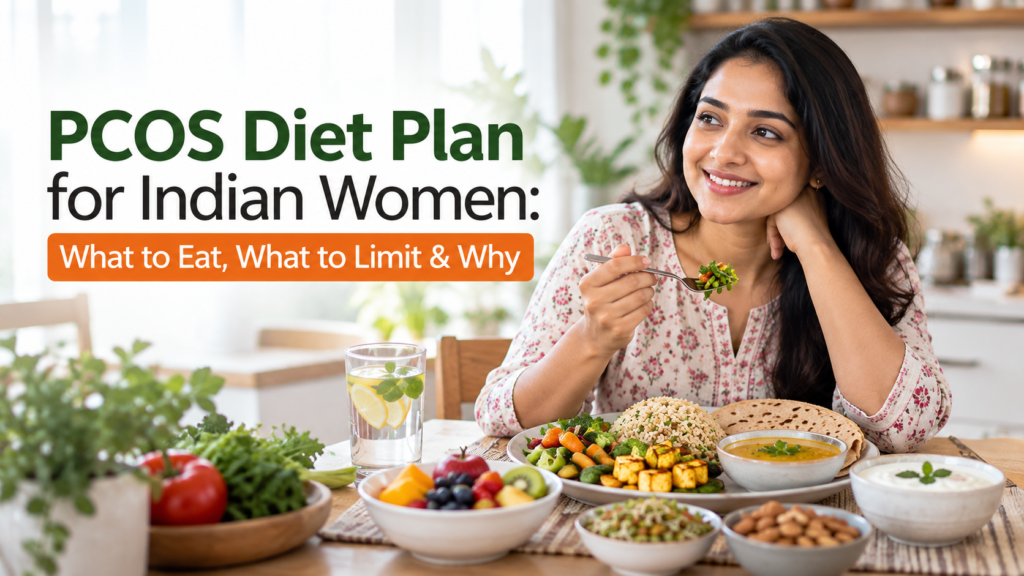
If you have PCOS, food advice can quickly become confusing.
Stop rice. Avoid dairy. Don’t eat fruit. Replace everything with millets. Cut carbohydrates. Try intermittent fasting.
You’ve probably heard at least a few of these.
But having PCOS does not mean you need to follow an extremely restrictive diet.
A practical PCOS diet should focus on balanced meals, adequate protein, vegetables, fibre-rich foods, sensible carbohydrate portions and healthy fats.
More importantly, it should be realistic enough to follow consistently.
Preethi’s Take
“PCOS nutrition is not about creating a longer list of foods you cannot eat. It is about learning how to build meals that work better for your body and are realistic enough to continue.”
— Preethi Gurajala, Clinical Dietitian
Quick Answer: What Should You Eat With PCOS?
A balanced Indian PCOS diet can include:
- Vegetables and leafy greens
- Dal and legumes
- Eggs, paneer, tofu, chicken or fish
- Curd and milk, if tolerated
- Whole fruits
- Rice, roti, oats and millets in suitable portions
- Nuts and seeds in sensible quantities
You do not automatically need to eliminate rice, fruit, dairy or carbohydrates because you have PCOS.
Instead, focus on what you eat, how much you eat and what you combine together in a meal.
Why Does Diet Matter in PCOS?
PCOS, or polycystic ovary syndrome, is a hormonal and metabolic condition that can affect periods, ovulation, fertility, androgen levels and metabolic health.
Insulin resistance is also recognised in many women with PCOS.
This does not mean every woman with PCOS has diabetes, nor does it mean carbohydrates need to disappear from your plate.
Nutrition can support your overall health by helping you build better eating habits, manage energy intake where necessary and improve the overall nutritional quality of your diet.
Physical activity, sleep and appropriate medical care are also important parts of PCOS management.
What Should an Indian Woman With PCOS Eat?
You do not need expensive imported superfoods to build a good PCOS diet.
Traditional Indian foods can work very well.
Think about your meals in three main parts.
1. Include Protein in Your Meals
Protein can help make meals more satisfying and supports muscle health.
Good vegetarian options include dal, curd, paneer, tofu, soya, chana, rajma, moong and other legumes.
Non-vegetarian options include eggs, fish, chicken and other lean meats according to your preferences.
One common mistake is assuming a small bowl of dal covers your protein requirements for the entire day.
Dal is nutritious, but your total protein needs should be considered across all your meals.
2. Eat More Vegetables and Fibre-Rich Foods
Include a variety of vegetables such as beans, bottle gourd, ridge gourd, okra, brinjal, cabbage, cauliflower, capsicum, cucumber, spinach and other leafy vegetables.
Vegetables provide fibre, micronutrients and volume to your meals.
Instead of eating the same vegetables every day, rotate different colours and varieties throughout the week.
3. Choose Sensible Portions of Carbohydrates
This is where PCOS diets often become unnecessarily restrictive.
You can still include:
- Rice
- Roti or chapati
- Oats
- Millets
- Idli
- Dosa
The goal is not to fear carbohydrates.
The better approach is to understand portion size, food quality and meal combination.
Can Women With PCOS Eat Rice and Roti?
Yes.
Most women with PCOS do not need to completely eliminate rice or roti.
A very large plate of rice with very little protein or vegetables is different from an appropriate portion of rice accompanied by vegetables, dal, curd and another suitable protein source.
The same applies to roti.
Roti is not automatically “good” for PCOS, and rice is not automatically “bad.”
Millets can also provide variety, but replacing a large serving of rice with a large serving of millet does not automatically make the meal healthier.
Instead of asking:
“Can I eat rice?”
A more useful question is:
“How much should I eat, and what should I eat with it?”
Can Women With PCOS Eat Fruit and Dairy?
Fruit
Yes. Whole fruit can generally be included in a balanced PCOS diet.
Fruit provides fibre, vitamins, minerals, water and beneficial plant compounds.
Fruit contains natural sugars, but whole fruit is not nutritionally equivalent to sweets or sugary beverages.
Where possible, choose whole fruit rather than fruit juice.
Dairy
Dairy does not need to be automatically eliminated because you have PCOS.
If you tolerate dairy, foods such as milk, curd and paneer can contribute useful nutrients, including protein and calcium.
Some women may have individual reasons to modify dairy intake, but PCOS itself does not mean everyone must follow a dairy-free diet.
What Foods Should You Limit With PCOS?
I prefer saying “limit” rather than creating a frightening list of forbidden foods.
Consider moderating:
- Sugar-sweetened beverages
- Frequent sweets and desserts
- Deep-fried snacks
- Highly processed packaged foods
- Refined bakery products
- Oversized portions
- High-calorie beverages
- Excess alcohol where applicable
This does not mean eating one sweet has suddenly “ruined your hormones.”
One restaurant meal does not mean your diet has failed.
Your overall eating pattern matters far more than one isolated food.
What Is a Good Breakfast for PCOS?
A good breakfast should provide adequate nourishment and ideally include some protein rather than being built entirely around refined carbohydrates.
Here are some practical Indian options:
Option 1: Moong dal chilla + vegetables + curd
Option 2: Vegetable dosa + sambar + egg or another suitable protein source
Option 3: Idli + generous sambar + suitable protein addition
Option 4: Vegetable omelette + roti or dosa
Option 5: Oats + milk or curd + nuts/seeds + suitable fruit
Option 6: Paneer bhurji + roti + vegetables
Instead of asking:
“Is dosa good or bad for PCOS?”
Ask:
“How can I make my dosa breakfast more balanced?”
That small change in thinking makes nutrition much easier.
Simple One-Day Indian PCOS Diet Plan
This is a general example and not an individual diet prescription.
Breakfast
Moong dal chilla + vegetables + curd
OR
Eggs + vegetable dosa
Mid-Morning
One whole fruit.
A suitable portion of curd or nuts can be added depending on your individual requirements.
Lunch
Rice or roti + vegetables + dal + curd + suitable additional protein.
Evening Snack
Roasted chana, curd or another suitable protein-rich snack.
Dinner
Rice or roti + vegetables + paneer, tofu, egg, chicken or fish.
Your actual portions depend on your age, height, weight, activity, health goals, medications, metabolic health and food preferences.
5 Common PCOS Diet Mistakes
1. Removing Too Many Foods
No rice. No dairy. No gluten. No fruit. No carbohydrates.
This quickly makes eating stressful and difficult to sustain.
Food restriction should have a reason.
2. Eating Too Little Protein
Eating vegetables and reducing rice isn’t enough.
Make sure your meals contain an appropriate protein source.
3. Assuming Healthy Foods Are Unlimited
Nuts, seeds and nut butters are nutritious, but they also contain significant energy.
Healthy foods still need appropriate portions.
4. Depending on Supplements
A supplement cannot compensate for an overall poor eating pattern.
Do not buy something simply because the label says “PCOS support.”
Your actual needs should be individually assessed.
5. Copying Someone Else’s PCOS Diet
Your friend has PCOS.
You have PCOS.
That doesn’t mean both of you need the same diet.
Symptoms, activity, body composition, metabolic health, medical history and goals can be very different.
Can Weight Loss Help With PCOS?
For women who are above their healthy weight range, appropriately managed weight loss may improve aspects of metabolic and reproductive health.
But the weighing scale should not become your only definition of progress.
Progress can also include better food habits, improved strength, more physical activity, better sleep, improved energy and better metabolic markers.
Women who are not overweight should not be encouraged to lose unnecessary weight simply because they have PCOS.
Frequently Asked Questions About PCOS Diet
What Is the Best Diet for PCOS?
There is no single best diet for every woman with PCOS. Focus on a sustainable eating pattern containing adequate protein, vegetables, fibre-rich foods, appropriate carbohydrate portions and minimally processed foods.
Can I Eat Rice Every Day With PCOS?
Many women with PCOS can include rice. Portion size, what you eat with the rice and your individual nutritional requirements matter more than automatically eliminating it.
Should I Completely Stop Sugar?
You do not need to treat an occasional sweet as a failure. However, frequently consuming sugary drinks, large amounts of added sugar and highly processed foods can make maintaining a balanced diet more difficult.
Can I Eat Bananas With PCOS?
Whole fruits, including bananas, can generally fit into a balanced diet. Individual portions may need consideration if you also have diabetes or abnormal blood glucose.
Is Intermittent Fasting Necessary for PCOS?
No. Intermittent fasting is not mandatory for managing PCOS. Some people may find structured eating windows convenient, while others may find them difficult to sustain.
Can PCOS Be Cured Through Diet?
Diet and lifestyle can support PCOS management and metabolic health, but nutrition should not be promoted as a guaranteed cure. Some women may also require medical management depending on their symptoms.
Final Takeaway
PCOS does not require a punishment diet.
Rice can fit. Roti can fit. Fruit can fit. Curd can fit.
And your favourite foods can fit too.
The goal is not to create the smallest possible list of foods you are “allowed” to eat.
Instead, build meals around:
Protein + vegetables + fibre + appropriate carbohydrates + sensible portions.
Most importantly, choose an eating pattern that works in your real life — not just for seven days or until you lose a few kilos, but as a sustainable approach that supports your long-term health.
Consult Clinical Dietitian Preethi Gurajala
Confused about what to eat with PCOS?
Struggling with weight management, insulin resistance, cravings or conflicting diet advice?
Nutrition With Preethi provides personalised nutrition guidance based on your health needs, food preferences and everyday Indian lifestyle.
Instead of copying another person’s PCOS diet, build a nutrition plan designed around you.
Phone / WhatsApp: +91 70970 99709
Email: nutrition.preethi@gmail.com
Website: nutritionwithpreethi.com
Written & Reviewed By
Preethi Gurajala, Clinical Dietitian
MSc — Nutrition, Biochemistry & Microbiology
This article is intended for general educational information and does not replace personalised medical or nutritional advice. PCOS symptoms, metabolic health and treatment requirements vary between individuals. Consult your doctor and qualified dietitian for recommendations specific to your health.